
“Suspicious package! Let’s go, Chief!” That was Lt Col Jones, hollering through my office doorway as she headed out to the parking lot. She was the 28th Mission Support Group Deputy Commander, and as such got to check out a whole bunch of the interesting stuff that happened on Ellsworth AFB, South Dakota, especially when the Commander was off doing something else and left her in charge, like now.
I was the Group Superintendent, and I got to tag along on all kinds of interesting things, too. The Mission Support Group was an umbrella that covered five different squadrons in those days: Communications, Mission Support, Services, Security Forces, and Civil Engineers — the framework that kept the whole base functioning. Today’s event involved four of them, and this was a great opportunity to not only provide a command presence, coordinate operations among squadrons, and handle liaison with Wing HQ, but also a chance for us to see some incredible troops demonstrating their professions.
I grabbed my hat and brick and we headed for the parking lot at a run. Side note for my civilian friends: a “brick” was called that because it was the approximate size, shape, and weight — and usefulness, if you forget to charge the battery — of its namesake. The folks in the Comm Squadron who managed the equipment and networks called it a land mobile radio, or LMR. I usually called it my electronic leash.
We arrived at the Services Squadron’s billeting area in minutes and joined one Security Forces checkpoint at the cordon they had already established. Traffic was being re-routed and personnel were being evacuated from the vicinity of the billeting lobby, and those in nearby facilities were notified and directed to shelter in place until the nature of the threat was assessed.
It was a small suitcase someone had left in the lobby when they checked out that morning. Or so it seemed. The problem with a situation like this is that bad guys succeed by making things look normal. Over the years, tons of innocent-looking objects have been discovered holding bombs, from fire extinguishers to pressure cookers to backpacks to shoeshine boxes to babies’ dolls. And they’ve succeeded way too often.
But this, of course, was just a collection of underwear that someone had overlooked in the hurry to get on the road. Probably. But efforts to get ahold of people who could have accidentally left this suitcase behind came up empty. Once suspicion is raised, you can’t afford to take chances until you know for sure. So now the experts would take over.
The Civil Engineers’ Explosive Ordnance Disposal team had responded in a flash and was setting up. Technicians had done a visual inspection and could see no external wires or triggering system. This called for a little more in-depth analysis.
Time to bring in the robot.
It trundled into the lobby on its twin treads like a miniature tank/erector set, controlled from a safe distance by a bomb technician at a console with a video screen. It unfolded its articulated arm, carefully gripped the suitcase handle, and slowly moved it away from the wall far enough to deploy the x-ray equipment.
No boom. That was good.
X-ray images are always a bit shadowy and it takes some concentration and patience to interpret them, especially when you don’t really know what to expect inside. The hope was for a few amorphous stacks of t-shirts and socks. But in the midst of miscellaneous clutter, there was no mistaking the outline of a cylindrical object and coils of wiring.
EOD shifted into high gear to set up the next phase of the operation and the cops swiftly evacuated all personnel remaining in nearby buildings.
You can’t rush these things, but you also can’t afford to waste too many tick-tocks of the clock. Explosives can be triggered by changes in time, orientation, position, or elevation. By bumps or vibration. By remote control. By stray electromagnetic signals, which meant we couldn’t use our bricks within a certain radius of the suspicious object. They didn’t have enough power to be considered a threat out here at the cordon perimeter, so we could still monitor traffic over the air and coordinate with the Wing. We waited and watched as well as we could from a distance as the scenario unfolded.
With the speed of a reluctant snail, the robot picked up the suitcase and crept out of the lobby and into the open where a bit less damage might occur if something went wrong. The suitcase was lowered to the ground delicately and the technician moved the robot into position to put its projected water disruptor into action.
These disruptors are amazing gizmos. This one, called a “pigstick,” used a small explosive charge, like a shotgun shell, to propel a cylinder of water at blinding speed into the targeted object. The shaped-charge water projectile can destroy a bomb by blasting the device apart and severing any detonating connections faster than any fuse or anti-tampering device on the bomb can react.
If everything goes right.
Technicians double- and triple-checked their setup and made sure, once again, that all personnel were out of the potential blast zone. The cops ensured the cordon was secure and all bystanders had been evacuated to a safe distance. The EOD guys were as cool as a mountain breeze, but they’d trained and trained and done this kind of thing over and over. It’s how you become a professional, and that they were. I, on the other hand, was a straphanger at my first event. I caught myself holding my breath.
There was a short countdown so we could all be prepared, and then. . .BOOM!! A flash and concussion, smoke and flying debris, and it was over. Not nearly enough explosion to damage a building or cause widespread casualties, so it appeared the disruptor had done its job. The bomb team moved in cautiously to assess the remnants in case there was still some live explosive that might yet detonate.
The technicians slowly moved through the wreckage, scanning the scattered, tattered, smoldering pieces of suitcase, shattered makeup containers, and smoking scraps of bras and panties. They finally discovered the cylindrical object and wiring seen in shadowy profile in the x-ray and examined it carefully.
My brick crackled to life and the verdict came across the airways: “The world has been rendered safe from. . .one ladies’ curling iron.”
All in a day’s work for the EOD gang and the cops. It isn’t always a terrorist or evil scientist or existential threat to the entire known universe, but it’s always something to approach carefully and professionally and with all the skill they can muster. ‘Cause you never know ‘til it’s over.
But sometimes it ends up being a really good laugh.
The poor retired colonel’s wife on vacation who lost her stuff, and finally called to see if it had been found? Well, she and the hubby were probably both more careful about counting suitcases after that.
And as for Lt Col Jones and me? We had a blast!
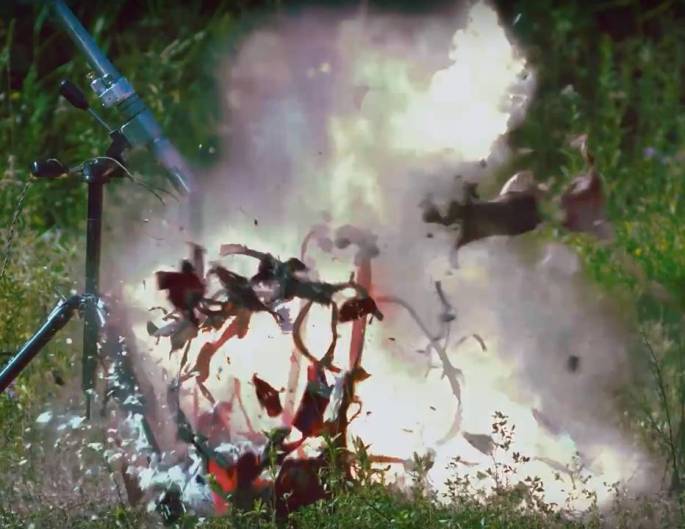
A projected water disruptor in action against a piece of suspicious luggage.
To see a video, click here.

 In A Tale-Spin