Thought For The Week

Here’s another great post from Jane Friedman’s blog, and I’ll pause right here to urge you to check out her website. It has tons of great information and I could bounce around reading blog posts all day and never run out of things to learn. Of course everything isn’t interesting to everybody, but there’s something there for everybody who writes, in one way or another. Of special note is her free email newsletter, which may or may not come with a new fascinating tidbit that’s pertinent to you every time, but hey…it’s email so it’s easy to check out and delete if it’s not up your alley.
This post is by book advertising consultant Matt Holmes, and it’s one of the most detailed, thorough, and well-illustrated discussions on marketing how-to I’ve ever seen, particularly for something free to whoever wants to go looking for it. And you can never have too much free advice. There’s one very significant thing about advice: you never really know whether it’s any good until after you’ve taken it. So consider it carefully and remember that even when you get good advice, it’s not going to do much good until you put time and effort and money into it. It’s advice, not magic.
I’ve only tried running Facebook ads a couple of times, and was unimpressed with the results, but I was trying it on my own, on the fly, without a clue. Experimenting. The task is complex, complicated, and daunting to the uninitiated, but made much clearer, right here, by someone with experience and success.
Writing a book is quite a daunting undertaking, too, but when you get done with it, you have to get it out there to people who want to read it or its purpose is never truly fulfilled. You do that by marketing it, and for most of us — the ones who end up self-publishing — that responsibility falls upon our own shoulders. And we need all the help we can get.
Here you go!
June 15, 2021 by Matt Holmes

Today’s post is by book advertising consultant Matt Holmes.
When authors want to advertise their books, three advertising platforms spring to mind for most: Facebook ads, Amazon ads, and BookBub ads.
And while each of these platforms can be amazing in their own right and even more so when used holistically together, without a strong foundation (i.e. a great book that has been edited and proofread, a strong book description, right pricing for your category or genre, a professional-looking book cover that fits in your genre, etc.), no amount of advertising can sell a poor quality book.
Once you have a strong foundation, the truthis that advertising takes time to perfect; it takes testing; it takes patience, persistence, and, ultimately, it takes money.
However, let’s brighten things up.
When you get your ads dialed in, they can truly transform your career.
As an example, my wife is an author of fantasy novels. Before we started advertising her debut series of books, we were lucky if they pulled in $40 per month!
Last month, this same series earned $8,550 in royalties, with $5,200 of profit—and that’s with just one series of three books; the fourth book is due out later this year.
And the advertising platform that did the brunt of the leg work was…
Facebook ads.
Let’s dive into it. Here’s what you’ll learn.
Facebook’s biggest and most valuable asset is data. As an advertiser on Facebook, you can tap into this data and pinpoint the exact people (readers) you want to reach with your ads.
As an example, if you know your readers:
You could potentially target them! Now, I wouldn’t recommend being this granular with your targeting; this is just an exaggerated example to show you how much Facebook knows about its user base. In fact, I have seen better results by leaving my targeting fairly open. I trust Facebook enough to go out and find the right people to position the books I’m advertising in front of.
Targeting is a big topic and what works for one author won’t necessarily work for another. However, myself and many other authors have seen the best results by targeting:
As long as your targeting is relevant to the book you’re advertising, it’s worth testing. That’s not to say that every target you test will be a winner, but the more relevant you can be, the higher the chance of your Facebook ads converting into sales and therefore providing you with a positive Return on Ad Spend (ROAS); in other words, profit.
When researching potential targets, I can’t recommend enough that you keep track of all your tests in a spreadsheet. I have built my own Targeting and Tracking spreadsheet which you can use for free; it’s included in my Author Ads Toolkit, which comes with several other valuable resources.
It’s also worth noting that Facebook ads allow you to advertise not just on the Facebook News Feed, although that is where you are likely to see the majority of your traffic coming from, but also on Facebook Stories, Instagram Stories, Instagram Feed, Facebook Messenger and many more.
Before we move on, let’s first take a quick look at what a Facebook ad actually looks like.
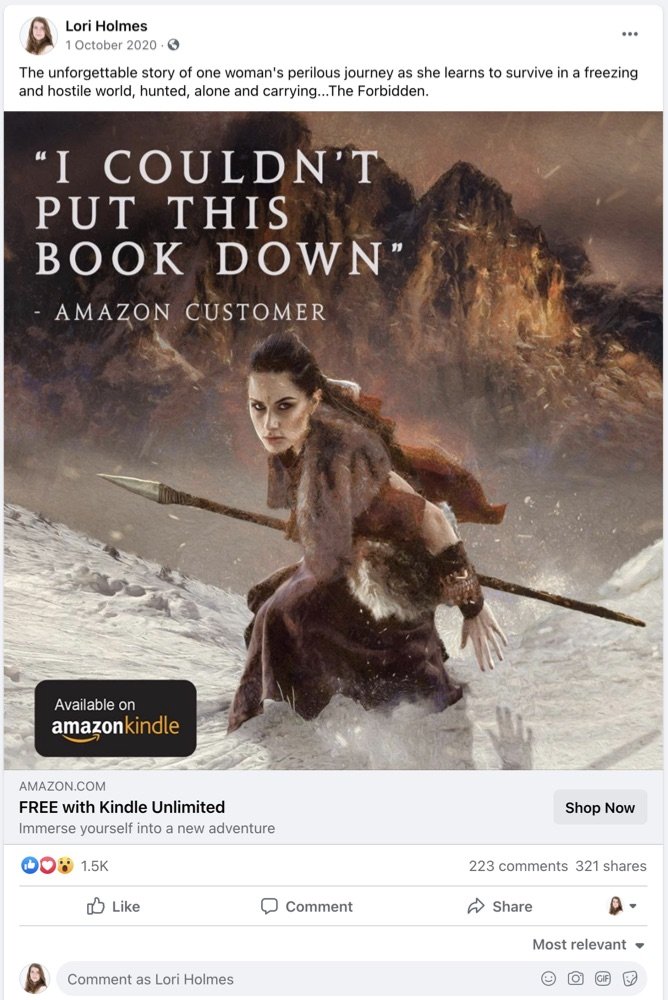
This is one of the ads I’ve run for my wife’s series of fantasy novels.
If you’ve spent any length of time scrolling on your Facebook News Feed, I’m sure you recognize the layout and style of this ad. As you can see, Facebook wants their ads to fit in with an organic post (i.e., not an ad) that you might see from one of your Facebook friends.
I’ll be walking you through the different assets that make up a Facebook ad, as well as some tips and best practices on how to create scroll-stopping ads.
Good question! And every aspiring word-wrassler wants to know the answer, but good, honest answers are a bit hard to come by. So I’m going to be embarrassingly up-front about my finances to start with, and hook you up with some good discussions about it shortly. Keep in mind that this is about fiction writing. There are many kinds of writing, and a competent person can make a good living in areas like copywriting, technical writing, and journalism without all the uncertainty involved with things like promotions, advertising, cover design, and begging their friends to buy their books and write reviews.
First up-front confession: I’ve published one novel. Okay, I self-published one novel. So far. So I haven’t been in this business for decades with vast amounts of experience battling the stingy moneybags of the publishing world. What I do have experience with is research and experimentation and the stories of a whole boatload of other people who have researched and experimented and battled the moneybags for decades. I’ll start with mine.
The bare facts are that in three years, I’ve sold 205 books. About a third of them were e-books, and of the two-thirds that were paperback, about half were sold through Amazon and I sold the other half myself, through my website or the mail or a couple of consignment sources or the cardboard box in the back of my car. I’ve brought in a whopping $940.07, which doesn’t sound bad for that number of books, but that isn’t profit. On the outflow side, I’ve spent $1,008.18 for printing, shipping, PayPal fees, advertising, cover design, and all that happy stuff. So, after three years, I’m still $68.11 in the hole.
Is that normal? Kind of. Everybody’s situation is different, and everybody has a different approach. I did all my own editing, formatting, uploading, and account management with Amazon and Draft2Digital, the companies that handle distribution of my book. Those functions are beyond the capabilities of some people, who would need to pay others to do that for them. On the other hand, if I’d had a professional editor go through my manuscript, it may have become so much better that it would have made more money.
Another example is the cover art…I paid a professional to do it even though I could have gone with something I cobbled together myself or used a generic one. But if I had, it wouldn’t be nearly as good and I may have lost sales to customers who were drawn to the book by the cover. Did it attract enough sales to make it worth what I paid? That’s almost impossible to know. You gamble with every aspect and do the best you can.
I know people who have invested a whole lot more and sold half as many books. Some struggle less and sell more, but from all my research, it looks like my start came out reasonably well compared to the vast armies of authors out there. What you have to understand is that the entire writing thing is a work in progress, just like that masterpiece you have partly bottled up inside you that needs to come to the surface, become complete, and get out there to amaze the world. The more you write, the better you get, the more worth your writing has, the more people will enjoy it, the more it will sell, the more money you make.
All the advice-givers come up with three great truths: 1. Don’t give up your day job. 2. The best way to increase sales is to write the next book. 3. You have to start with a measure of talent, but the greatest indicator of how much money you make is how much effort you put into it.
The result of my first foray into authorhood is that I’ve basically spent that $68.11 on a tremendous education in the ins and outs and obfuscations of the publishing world. I’m working diligently on the next novel and I know a whole lot more about the business, so everything will come a little easier and smoother this time and the next time and the next time. And that’s what life’s all about.
So here’s that extra discussion I promised, with the wisdom of Jane Friedman — author, blogger, professor, and advice-giver. It’s not just her blog post that has a bunch of info in it…three links she posts at the beginning have much more detail and discussion about a lot of aspects of this subject. So chase those links as much as you care to, and learn all you can, and get out there to take on the world of writing armed with more of an understanding of what you’re getting yourself into than most word-wrasslers.
Good luck.
Posted on by Jane Friedman
In the last month, there have been a few informative articles discussing how much authors earn:
All of these are excellent pieces, written and reported by people bringing transparency to the money side of the writing life. If you go and read them, you’ll have a meaningful education in what to expect as a writer if you’re just starting out. This is a subject near and dear to my heart and why I wrote The Business of Being a Writer. I’d heard too often—usually from speakers at AWP—that they wish someone had told them, before they went into six-figure debt for their MFA, that writing doesn’t pay that well. Not even a minimum wage.
So I’m always happy to see the veil lifted. We need more discussion of what writers earn, with specific authors talking about their advances, royalties, sales, expenses, connections that led to earnings and profitable gigs—all of it. In an industry where talking about the money is often taboo or even shameful (few want to admit how little or how much they earn), the more we all open up, then the more we can normalize the practice of talking about art and commerce, and the more people can make the best decisions for their careers. And I’ll disclose my own book earnings by the end of this post.
OK, now that I’ve gotten that out of the way, here’s the thing: I do not like this question. Of course I understand why it’s asked, and I empathize with those who ask it. But it’s like asking what does a musician earn? Or what does an artist earn? The answer will be influenced by all kinds of factors that may or may not apply to you—and that are entirely misleading about your own potential.
So, with the posts above, you’re going to find limitations. Someone will react to the information and say, “BUT [exception here].” From my POV, these exceptions can often be categorized thus:
This is also why it is a tortured exercise to try and run any kind of meaningful survey on what authors earn. I’ve written at length about the problems of these author earnings surveys. However, authors organizations engage in these surveys regularly, partly because they have to. How else can they pressure lawmakers and advocate for their members? They need some kind of evidence that says, “Look! Writers are suffering. They earn less than ever before. This is an emergency!”
Is that true?
No.
But is publishing and literary culture changing?
Yes.
Are the changes bad?
It depends on who you ask.
It never hurts to get a little booster shot of advice. There are books, workshops, podcasts, interviews, columns, and blogs galore about writing — how to do it, how to make it better, how to sell it, what to do, what not to do, who to listen to — and almost anybody you ask about it will have an opinion and will be happy to share it with you. And a lot of people you don’t ask will try sharing it with you, anyway. So here I am, right on cue.
So yeah, advice is all over the place and sometimes it’s a tad overwhelming. But sometimes you’ll find an angle that gives you a little more incentive, or a little more hope, or maybe an aspect that hadn’t occurred to you and helps you understand your motivation or your plot or your characters a little better. And sometimes you just need a reminder of something you already knew was good advice but has gone a little out-of-focus, or slipped gradually out of your mind while you were distracted with that masterpiece of yours that hasn’t been behaving like you thought it would.
What’s nice is to find some thoughts on which a whole lot of writers have reached a consensus. Enter Joe Fassler. Mr. Fassler is a writer, journalist, and editor who has discussed the art of writing with a whole bucketful of writers, and condensed their best advice down to seven nuggets of wisdom in this post from Literary Hub. When you get through with his article, scout around on the Literary Hub website a little and see what else you can relate to.
I’ll have to confess that for quite some time I haven’t been attentive to that website, because they’ve been doing a considerable amount of liberal pontificating in their newsletters and material. Let me be clear…there’s absolutely nothing wrong with liberals and their thoughts. However, when subjects are almost exclusively about LGBTQ pride, militant feminism, racial equality, and hating the last President — let’s face it, LitHub — it’s a crusade and it ignores a huge percentage of the rest of the literary world. All those subjects are fine, but a constant barrage gets a bit tiresome, and they could be a little more tolerant and inclusive with the rest of the literature firmament. When they are, you can find a lot of good information there, so keep your mind open if some of it seems a little narrow-focused at first glance.
These are common rivulets running through the creative watershed of the entire literary landscape, so if you’re a writer, of any genre or category, this has to do with how you do what you do, and deserves a look-see.
By Joe Fassler
I once heard John Irving give a lecture on his process at the Iowa Writers’ Workshop, an in-depth account of the way his novels come to be. He kicked it off by writing a single sentence on the chalkboard—the last line of Last Night in Twisted River. All his books begin with the ending, Irving explained, a capstone he works and reworks until it’s ready. From there, he’ll generate a detailed summary that ultimately builds towards the finale, like SparkNotes for a book that does not yet exist. Only when he has the synopsis and last sentence in hand will he actually start writing.
I remember being fascinated by this. The approach had clearly been successful, and made sense in theory, and yet was so unlike any creative strategy that had ever worked for me. Which is an important thing to keep in mind when trafficking in the familiar genre of writing advice: Just because John Irving does it that way doesn’t mean you should. Not only is every writer different, but each poem, each story and essay, each novel, has its own formal requirements. Advice might be a comfort in the moment, but the hard truth is that literary wisdom can be hard to systematize. There’s just no doing it the same way twice.
And yet. In the five years I’ve spent interviewing authors for The Atlantic’s “By Heart” series—the basis for a new collection, Light the Dark: Writers on Creativity, Inspiration, and the Artistic Process—it’s been impossible to ignore the way certain ideas tend to come up again and again. Between the column and the book I’ve engaged a diverse group of more than 150 writers, a large sample size, that nonetheless has some defining traits. Here are the recurring ideas, distilled from dozens of conversations, that I think will most help you—no matter how unorthodox your process, how singular your vision.
1.
Neglect everything else.
It starts with a simple fact: If you’re not making the time to write, no other advice can help you. Which is probably why so many of the writers I talk to seem preoccupied with time-management. “You probably have time to be a halfway decent parent and one other thing,” David Mitchell, the author of Cloud Atlas, told me. That can mean mustering the grit to let other responsibilities languish. As he put it in short: “Neglect everything else.”
Many authors need to put blinders on, finding ways to simplify their experience and reduce the number of potential distractions. That might mean consistently keeping a single two-hour window sacred, as Victor Lavalle does, morning time he safeguards against the demands of parenting and full-time teaching. For others, it means finding ways to ward off digital derailment. Mitchell does this by setting his homepage as the most boring thing he can think of: the Apple website.
Ultimately, the literary exercise is about finding ways to defend something fragile—the quiet mood in which the imagination flourishes. As Jonathan Franzen put it: “I need to make sure I still have a private self. Because the private self is where my writing comes from.”
2.
Beginnings matter.
Everyone knows that the opening line is a crucial invitation, something that can make or break a reader’s interest in a book. But far less attention has been paid to the role first lines play for writers, leading them through the work’s dark, uncertain stages like a beacon.
“The first line must convince me that it somehow embodies the entire unwritten text,” William Gibson told me, a radical, koan-like conviction that nonetheless seems to be commonplace. Stephen King described spending “weeks and months and even years” working on first sentences, each one an incantation with the power to unlock the finished book. And Michael Chabon said that, once he stumbled on the first sentence of Wonder Boys, the rest of the novel was almost like taking dictation. “The seed of the novel—who would tell the story and what it would be about—was in that first sentence, and it just arrived,” he said.
 In A Tale-Spin