Thought For The Week

It is rather for us to be here dedicated to the great task remaining before us — that from these honored dead we take increased devotion to that cause for which they gave the last full measure of devotion — that we here highly resolve that these dead shall not have died in vain — that this nation, under God, shall have a new birth of freedom — and that government of the people, by the people, for the people, shall not perish from the earth.

– Abraham Lincoln


A Military Eyeball On The Age Of Corona

May is Military Appreciation Month, full of special days like Loyalty Day, Military Spouse Appreciation Day, Armed Forces Day, and Memorial Day.  All the celebrating is nice.  Our military folks do, and have done, a lot for us, and it’s good to show gratitude.

So while we’re appreciating our military, maybe it would be a good time to look around and notice who you don’t see having conniptions about this virus phenomenon — in large part, our military members and veterans.  Maybe we can appreciate learning a lesson from them.

There are a lot of things that become a part of your life when you’ve spent time in the military, especially for those who make a career out of it.  A lot of these things are pertinent to what’s going on around us now.  Like being told you have to stay in one area for an extended period of time and not being able to leave.  Having certain locations be placed off-limits.  Being scrutinized to make sure you’re wearing the proper accouterments.  Having nothing at all to do for hours and hours, sometimes days and days, and then having everything to do all at once.  Eating things you are definitely not fond of, or going without.  Finding yourself in weird circumstances and having to figure out what to do to keep from dying, or getting injured, or being very, very sick.  Not being able to see or be with your loved ones for what sometimes seems like an eternity.

You learn to deal with it, because you have to.

The mission comes first.  You have to do what it takes to accomplish the mission, in the most effective and efficient manner possible, with minimum damage to personnel and infrastructure.

And you have to learn to perform the mission under trying circumstances.  Troops drive trucks, set up command centers, repair equipment, communicate, wield weapons, and generate aircraft sorties while wearing bulky suits, rubber boots and gloves, helmets, flak vests, web gear, and chemical warfare gas masks, for hours and hours and hours on end.  They practice using chemical agent detection kits, decontamination wipes, brushes and hoses and kitty litter shuffle boxes, and nerve agent antidotes.

Some of us spend 20 or 30 years getting really good at doing all that stuff, and then we enter the Age Of Corona.  We need to spend a little more time at home on the couch binge-watching MeTV.  We need to keep our distance, go down one-way aisles at Walmart, wear little masks, and wash our hands frequently.  Pfffft.

Don’t get me wrong.  This is a serious disease threat and there’s no cure or vaccine yet.  People are dying, sometimes with horrifying swiftness, excruciating pain, and bizarre symptoms that nobody understands yet.  People are scared, the economy is crumbling, life has turned upside down in many ways, and we don’t know what’s going to happen next.

But it’s a matter of perspective.

Military folks have to make choices the same way other people do, but a lot of the time it’s sudden and unexpected and life-or-death when they’re faced with a choice.  Frequently, that’s a very hard choice to make.  In the case of this pandemic, it isn’t.  It’s common sense.

The mission is to keep our country operational and our lives functioning as well as possible.  We have to do that as effectively and efficiently as we can, with minimum damage to personnel and infrastructure.

It’s common sense that we can minimize our losses by keeping our distance, wearing masks, and sanitizing as best we can, and there are many ways we can do that.  But there’s such a thing as overkill.  We’ve shut things down and flattened the curve of infection, but staying shut down for too long will have farther-reaching consequences, including civil unrest, financial instability, unemployment, poverty, despair, drug addiction, alcoholism, homelessness, suicide…the list goes on.

You don’t liberate a village by shooting everybody in it…you only shoot the bad guys, or what’s the point?  You have to find the balance.  Accomplish the mission and minimize loss.

So we need to open up as much as we can and protect ourselves as much as we can while doing it.  BOTH.  It’s not rocket science…it isn’t even military science.  It’s a lot like driving a car.

We lose 40,000 people a year in automobile accidents, but we don’t ban them, or build them like tanks, or limit speeds to 5 mph.  That would make them safer, but inefficient and ineffective.  We take reasonable precautions to balance the risk.  Of course, there are always people who ignore speed limits, traffic lights, and double yellow lines.  You have to watch out for them and protect yourself by driving defensively or staying off the road.

Those are the same people who refuse to keep their distance or wear masks or sanitize when a virus goes galloping about the planet.  You have to watch out for them and stay on the defense or stay home.  Reasonable precautions.  That’s how we accomplish the mission while minimizing loss.

Another part of the military perspective: you don’t get anywhere by panicking, yelling, pointing fingers, and getting indignant about how stupid other people are and how they’re doing the wrong thing.  You’re just wasting energy, time, and resources, and distracting yourself and everybody else from the mission.

Our leaders are there for a reason.  We need to work within the guidelines they establish as well as we can, and if we have a better way, tell them.  And let them lead.

Let’s work together, figure out the best way to do it, and do it.

Improvise, adapt, and overcome.

We can do this.  We don’t really have a choice.


Thought For The Week

Your mother is always with you! She’s the whisper of the leaves as you walk down the street. She’s the smell of certain foods you remember, flowers you pick, the fragrance of life itself. She’s the cool hand on your brow when you’re not feeling well. She’s your breath in the air on a cold winter’s day. She is the sound of the rain that lulls you to sleep, the colors of a rainbow. She is Christmas morning. Your mother lives inside your laughter. She’s the place you come from, your first home. She’s the map you follow with every step you take. She’s your first love, your first friend, even your first enemy. But nothing on Earth can separate you. Not time. Not space. Not even death.

— Deborah R. Culver

Shakespeare And Me

Forsooth!  Fivesooth, even!

Extra points if you read that in Snagglepuss’s voice.  Or even know who he is.  But I digress.

Today is National Talk Like Shakespeare Day!  That’s because it’s April 23rd, the anniversary of both his birth and death, in 1564 and 1616, respectively.  So I thought it fitting that I share my own personal Shakespearean tale.

I was stationed in South Korea with a squadron providing Close Air Support near the DMZ.  The commander discovered that I was reasonably proficient in grammar and spelling, and I was eventually rewarded (?) by being allowed (?) to review every…single…dadburned performance report, decoration submission, and award package for the entire squadron.  So be cautious about doing things well, because they may become your full-time job.

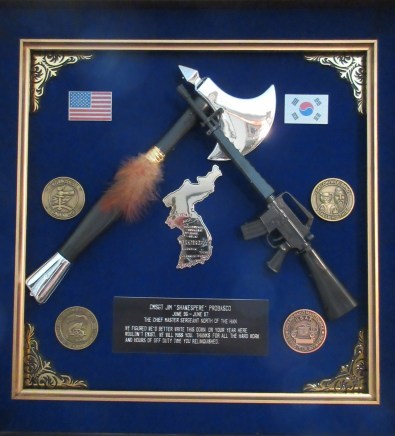
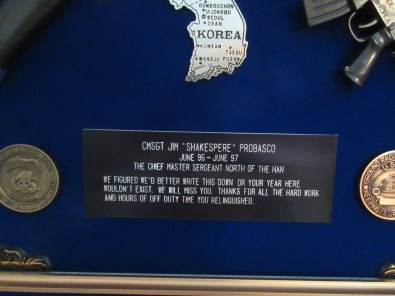
But back to the story.  The commander was pleased enough with my word wrassling that he wrote in my performance report, in a wild burst of blazing hyperbole, that I “could teach Shakespeare to write.”  It was nice of him to say so.  And then the sentiment was made even more immortal in the going-away shadow box I was given when I finally finished my tour and headed back to the States.

I’ve happily displayed the shadow box on my office wall since then, not only as a reminder that I survived what the assignments folks at Randolph AFB called the “worst assignment in the Air Force for a Chief,” but also because it’s a delightful case of Shakespearean literary irony.  I get a chuckle every time I see it.

Do you see it?

IMG_2721 straightened & cropped
IMG_2725


Shakespeare & The Plague

Here we are, all quarantined up and biding our time until the current pestilence is under control.  Some of us have extra time on our hands, and hopefully we’re using it wisely.  If you’re a writer, it would be a perfect time to write.  And that might be one of the things you didn’t know about William Shakespeare and how his writing was inextricably linked to the plague, in so many ways.

He wrote when his troupe couldn’t perform because of the plague.  The plague is what turned Romeo and Juliet into a tragedy.  The plague thinned out his competition and enabled his collaborations.  Yup, there were a whole lot of really, really bad things about the plague, but ol’ Will managed to make it work for him.

Here, from Slate.com, is a fascinating piece about all that, by Ben Cohen, adapted from his new book, The Hot Hand: The Mystery and Science of Streaks.  And it might just give you a tip or two about turning adversity into advantage.

The Infectious Pestilence Did Reign

How the plague ravaged William Shakespeare’s world and inspired his work, from Romeo and Juliet to Macbeth.

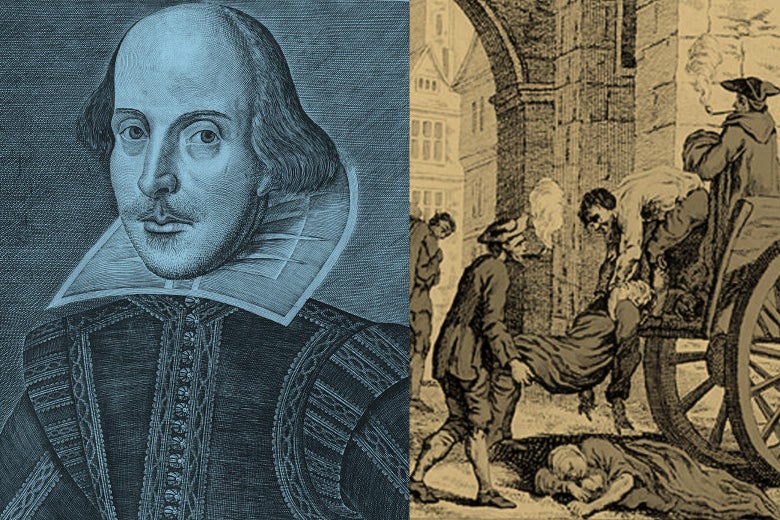
Diptych of a portrait of Shakespeare and an illustration of the plague.
The Bard survived the plague, referenced it in some of his most famous plays, and took advantage of it.
Photo illustration by Slate. Photos by Beinecke Rare Book & Manuscript Library, Yale University/Martin Droeshout/Wikipedia and Theloveforhistory.com.

One summer day in 1564, a weaver’s apprentice died in a small village in the English countryside, a local tragedy that was immortalized in the margins of the town’s records. Next to the name of the weaver’s apprentice were three ominous words: “Hic incipit pestis.”

Here begins the plague.

The plague wiped out a sizable portion of this particular town. Who lived and who died was seemingly a matter of chance. The plague could decimate one family and spare the family next door. In one house on a road called Henley Street, for example, was a young couple who had already lost two children to previous waves of the plague, and their newborn son was 3 months old when they locked their doors and sealed their windows to keep the plague from invading their home again. They knew from their unfortunate experience that infants were especially vulnerable to this morbid disease. They understood better than perhaps anyone on Henley Street that it would be a miracle if he survived. It was as if every family was flipping a coin unfairly weighted toward heads and betting a child’s life on tails. But when the plague was done with this small village in the English countryside, a little town called Stratford-upon-Avon, the couple breathed a sigh of relief that their young boy was still alive. His name was William Shakespeare.

There’s a possibility that Shakespeare developed immunity to the plague because of his exposure when he was an infant, but that speculation began only centuries later and only because the plague was a constant nuisance to Shakespeare. “Plague was the single most powerful force shaping his life and those of his contemporaries,” wrote Jonathan Bate, one of his many biographers. The plague was naturally a taboo subject for much of Shakespeare’s writing career. Even when it was the only thing on anybody’s mind, nobody could bring himself to speak about it. Londoners went to the city’s playhouses so they could temporarily escape their dread of the plague. A play about the plague had the appeal of watching a movie about a plane crash while 35,000 feet in the air.

But the plague was also Shakespeare’s secret weapon. He didn’t ignore it. He took advantage of it.

One example of this curious phenomenon is Romeo and Juliet. It’s basically impossible to appreciate the truly bonkers nature of this play when you read it for the first time. So let’s do it now. You probably remember the basics of the plot: Romeo and Juliet are born into rival families; Romeo and Juliet fall in love; Romeo and Juliet die. But do you remember how any of that happens? Maybe not. And did you know the plague is what ultimately drives Romeo and Juliet apart? I bet you didn’t. Maybe you vaguely recall the only explicit mention of plague in the entire play: “A plague o’ both your houses!” Mercutio says on his deathbed. But the plague is actually everywhere in Romeo and Juliet.

Read More…Click Here!