The War Of The Words

If you’re a lingo lover and enjoy conversations about how words evolve and spats over usage, here’s a good article I just found in The Guardian, by David Shariatmadari.  I’d take issue with the claim that these are the 19 Greatest Spats, but there’s some good background and interesting discussion.  Some of the comments are good, too… “The frequent use of Z in place of S is entirely due to the bloody Americans who owe us billions for using our language without agreement. Bloody Americans.”

Language wars: the 19 greatest linguistic spats of all time

by David Shariatmadari

Words are ever evolving – but not without controversy. From creative applications of an apostrophe to the overuse of literally, what makes you rage?

What is it about language that gets people so hot under the collar? That drives them to spend hours arguing with strangers on the internet, to go around correcting misspelt signs in the dead of night, or even to threaten acts of violence? The languages we speak are central to our sense of self, so it is not surprising that their finer points can become a battleground. Passionate feelings about what’s right and wrong extend from the use of “disinterested” to what gay people are allowed to call themselves. Here are some of the most memorable rows, spats and controversies.

Apostrophe catastrophe

A so-called “grammar vigilante” has been correcting shop fronts in Bristol, England, for more than a decade. His pet peeve is the confusion of plain old plurals with possessives, which in English are usually marked by an apostrophe followed by an S. Confronted with a sign advertising “Amy’s Nail’s”, he will obliterate the second apostrophe with a sticker. Addressing the potentially illegal nature of his mission in a BBC report, he said: “It’s more of a crime that the apostrophe is wrong in the first place”. Linguist Rob Drummond disagrees: “Fetishising the apostrophe as if its rules are set in stone,” he writes, “and then fostering an environment in which it is acceptable to take pleasure in uncovering other people’s linguistic insecurities is not OK.”
Read more…

Writing Tip: It’s Great to Suck at Writing

A good perspective on writing, this time from Karen Rinaldi on Writer’s Digest.  It resonates with me, like it should for every writer, because every writer sucks at writing sometimes.  You could set that to a Dean Martin tune to help keep it in your head to remind you that, as I like to stress to myself, you’re not in this alone.  Everybody’s gone through what everybody goes through.  So here’s Karen Rinaldi and a good discussion on sucking:

It’s Great to Suck at Writing

Author Karen Rinaldi sucks at surfing, but she continues to dedicate hours to it anyway, and she explains why we should also be okay with failure in many forms—even our writing.


I’ve spent the last two decades devoting myself to an activity that I will never master. Worse, I will never even reach mediocrity. I surf. And I will always suck at surfing. Even though the calculus of hours spent as a factor of my skill level doesn’t seem to justify continued effort, the joy I get from trying (and often failing) makes it worth it because it’s great to suck at something.

And nothing gets us acquainted more quickly with sucking at something than being a writer.

WD-writingsucks-rinaldi-AWD-writingsucks-rinaldi-B

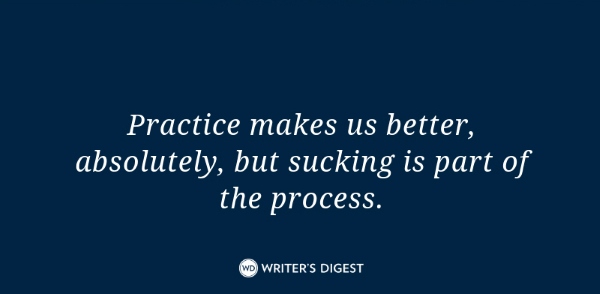
Surfing and writing are not dissimilar. One embodies physical chaos and the effort it takes to perform within it; the other involves internal chaos and the effort it takes to make sense of it in the form of words. The satisfactions of a well-ridden wave and a well-written sentence bring hits of pleasure that compel me to keep trying to do it again and again. But as any surfer or writer knows, catching a wave and writing well are harder than they seem. Practice makes us better, absolutely, but sucking is part of the process, so it’s best to make it our friend and not our enemy.

So many things are harder than they seem when performed by people who know how. “How hard can it be?” is both the arrogance of the clueless and the fuel of delusion. We learn the hard way because it’s the only way. All of the nonsense about short-cutting your way to success is all a big fat lie. Only by doing and failing, writing and revising, paddling and wiping out will we experience or create anything worthwhile. It’s always harder than it seems. If we embrace sucking at something, we’ll develop the temerity to not quit and to push through the discomfort of knowing we aren’t the master of anything and then continue to do it anyway.

Read more…