A happy family is but an earlier heaven.
—George Bernard Shaw

A happy family is but an earlier heaven.
—George Bernard Shaw
Be thankful we’re not getting all the government we’re paying for.
— Will Rogers
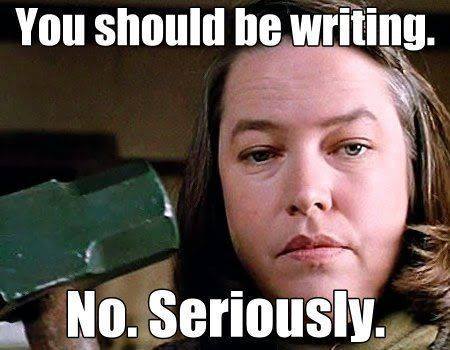
All of us put it off. At least sometimes. I don’t really think it’s easy for 95% of us to just sit down and write when we should. And most of us know that.
So what do I do to make sure I write when I should? HAH! The same thing you do…wish I was better at making myself write, and then every once in a while I overcome my inertia and write a little, and then tell myself, “That felt good, self! You oughta do that more often!” And then I get distracted by the world and forget my good intentions. Again.
Then I run across an article somebody wrote to give all of us a good kick in the pants so we’ll realize what we’re doing and get back to business. So here I am, being your kick in the pants by sharing this article that gave me a kick in the pants.
A lot of people know about Kirkus Reviews…they charge you an extremely large (from my frugal point of view) fee to read your book and write a really good review (that doesn’t necessarily mean favorable) so you can post it hither and yon to help market your book. Some people get really good results, and some not so good, but that’s not the point right now. What a lot of people don’t know about Kirkus Reviews is that they also have a lot of handy stuff on their website, with helpful stuff about writing and publishing and marketing. It’s worth taking a gander now and then to see what you can run across.
I signed up for their email newsletter and sometimes I get some good, meaty articles that discuss my bad habits enough to get me to chastise myself, and sometimes that’s enough to get me to make progress. So here’s one by Hannah Guy, and I’ll let her do the pants-kicking from here on out. Pay attention. She’s talking about you.
With tons of writers fresh off National Novel Writing Month (NaNoWriMo) and others inspired by the promise of the new year, it’s a great time to tackle a new project—or continue working on your current one. But there are still a few folks putting their breaks on.
How many of us want to dive into something like NaNoWriMo but never manage to get into it? And what about the other eleven months of the year?
Chances are, there’s a good reason you’re not writing the book you want to write—or at least you’re telling yourself it’s a good reason. Time for some straight talk: Enough procrastination, friends. Here’s how to get to work.
Of all the complaints writers have, time is often their biggest challenge. For those authors fortunate enough to make books their career, it’s less of a problem (and they’re usually the first to admit how fortunate they are). However, the rest of us are not so lucky. Families, full-time jobs, freelancing, personal disasters, commitments, volunteer work, and even illness all conspire to eat up most of our days. Then you add in necessary details like food, sleep, hygiene, occasional visits with friends and family, laundry, chores, traffic—well, you get the point.
So how do you find time to write your book? Well, the answer is deceptively easy-sounding: you make the time. We know, we know. Easier said than done. But truly, you can. They key is prioritizing it. Here are a few ways to make room in your life for your book:
In many parts of society today, whether in popular culture, academia, the media, or politics, there is a tendency to falsely equate noise with results. Some people think that you have to be the loudest voice in the room to make a difference. That’s just not true. Often, the best thing we can do is turn down the volume. When the sound is quieter, you can actually hear what someone else is saying. And that can make a world of difference.
— Nikki Haley
How far you go in life depends on your being tender with the young, compassionate with the aged, sympathetic with the striving and tolerant of the weak and strong. Because someday in your life you will have been all of these.
— George Washington Carver
An optimist stays up until midnight to see the new year in. A pessimist stays up to make sure the old year leaves.
— William E. Vaughan
Maybe Christmas…doesn’t come from a store. Maybe Christmas, perhaps, means a little bit more.
— Dr. Seuss
I run across writing tips all the time. Maybe that’s because I keep looking for them. A lot of them seem to be pretty redundant, but I keep reading them whenever I see them, because even when somebody says the same thing somebody else said, they frequently say it in a new way. It always gives a bit of fresh perspective, maybe a new way of doing what you’ve been trying to do that makes it easier. And every time I read the same advice, it’s reinforced and bolsters my resolve. At least a little.
There are a few points I try to focus on, and I string them together into something of a mantra. If I tell it to myself often enough, maybe I’ll have the tight focus that will keep me moving ahead. Worth a try. It’s like this:
Make time. Persist. Rewrite.
That pretty much says it all, right there in the proverbial nutshell. It covers most of the basics, at least. The important thing is that you have to keep it in mind and take it to heart. And those specific thoughts are recurring themes in tips from others, just laid out a bit differently, which enhances perspective in case that makes it easier to keep it in mind and take it to heart.
So there I was, wandering around the internet, and I found a few tips consolidated from this year’s Writer’s Digest Annual Conference…and there was my little mantra, splattered all through everybody else’s explanations of what helps you be a good writer. But with perspective.
So it’s worth passing along to whoever might be interested. And if you really want to be a good writer, you should be interested. Never pass up advice. You should think it over and decide if it’s right for you, but don’t pass it by, because you never know if this might be the big revelation you need. That tip was free. You’re welcome.
Here’s what the Writer’s Digest folks came up with:
If you ask 10 different writers for tips on writing, chances are you’ll get 10 completely different—sometimes contradictory—pieces of advice, as the writing process is a little different for every author. There are some fundamental truths that most writers agree on, though, particularly when it comes to approaching first drafts and committing to the process of writing itself.
We asked some of our WDC19 speakers for their favorite writing tips, and their responses were practical, inspirational, and—somewhat surprisingly—pretty consistent.
CARLA HOCH (Fight Write, WD Books): Tosca Lee once told me to write the first draft like nobody will read it. That really takes the pressure off.
STEVEN JAMES (Synapse, Thomas Nelson): Never fall in love with your first draft. Too many people with great ideas end up settling on an early draft when they really need to keep revising their story. I remember revising the first chapter to one of my books more than 50 times. It was brutal, but essential. That opening chapter remains one of the most powerful I’ve ever written.
Politics is supposed to be the second-oldest profession. I have come to realize that it bears a very close resemblance to the first.
— Ronald Reagan
There’s nothing stronger than the heart of a volunteer.
– Lt. Col. Jimmy Doolittle
 In A Tale-Spin