Thought For The Week

The query — it’s how you get somebody to agent or publish your writing. Some of us are well-worn and weary from ages on the Query Quest, striving to create the perfect submission that will make the world yearn for our wondrous weaving of words. Some are just starting. Many writers aren’t really yet aware that the quest awaits them. And it may not actually be an obstacle for many writers, depending on what they write and how they intend to get it out to the world, but it ends up being pretty important if you want to sell something to a large publishing house and make that elusive best-seller list.
If you have queried and queried and still haven’t managed to become world-famous, take heart because you’re far from being alone. You’re in quite a huge company, as a matter of fact. If your novel is finally ready for publication and you’ve discovered that now you need to learn how to write and send out a query, and now it’s going to take even longer to reach that pinnacle, you’re also in a pretty large group.
Here’s a tip: start learning about querying while you’re still writing that epic tale. Right now. It takes a lot of work just tracking down all the information on how the whole thing works, not to mention figuring out the best way to write a query letter, create a synopsis, find the right agents to present it to, and even figure out exactly what genre you just wrote that masterpiece in. Learn as you go, so when your baby is ready to be put out there, you’re ready, too.
To help with a little perspective, here’s a column by Catherine Baab-Muguira on the excellent Jane Friedman website. It’s short but well-written and explains not just how she finally broke a long streak of disappointment, but also several other things she learned along the way. Maybe reading this will help you learn the lessons without having to go through the same slow and painful journey, and at the least will remind you that if you’re having query angst, you share it with many. Many, many, many.
Take a look, and cruise around the Jane Friedman site while you’re there. Sign up for a newsletter. Learn everything you can while it isn’t painful. Start now.
Posted on by Catherine Baab-Muguira
Today’s post is by author Catherine Baab-Muguira (@CatBaabMuguira). Her book, Poe for Your Problems, releases in September 2021.
About a week before my nonfiction debut went to auction, I received two requests from editors who planned to bid if I did what they asked. The first editor wanted me to take my 4,000-word writing sample and rewrite it in a purely comedic vein. The second requested a rewrite, too, only he wanted me to make the book ultra-serious. No jokes.
It was 2019. I was childless, but I did have a demanding full-time job I couldn’t shirk, so I got up at 5 a.m. every morning and banged out new drafts before work. In the evenings, my friend Lizzie hunkered down beside me while, over beers and takeout, I walked her though the new material. Then we punched it up, or slathered on the sad. The adrenaline rush of all this was real, and also very far from pleasant. I felt like the comedy-tragedy mask come to unshowered, greasy life. If I didn’t satisfy both briefs, my book might not sell.
A dozen years prior, when I’d first started trying to get a book published, I wouldn’t have been up to the task. Fortunately, by the time all this went down, I’d already spent 12 years in the query trenches. I’d also spent a year in L.A. pitching movie ideas to producers in deep V-necks who absolutely loved the idea, wow, beautiful, brilliant, only change the entire thing, okay?
It’d been like a fitness boot camp for my ego: sadistic and deeply wrong, probably in violation of multiple health-department codes. In the end, though, I was glad to have survived, and the conflicting requests found me in shape. I’d already made pretty much every stupid, humiliating mistake you can make. Perhaps without all those years of unanswered emails, form rejections, close calls and ghostings, I would’ve been tempted to be like but but but! How dare you question my Art!
Instead, my feeling was: Thank you for the suggestions. Hand me that brief. Lemme see what I can do for you.
This kind of compromise isn’t for everyone, I realize. Depending on your ambitions, your age, where you are in your writing career and/or the happiness of your childhood, you may be on a different path. My goal was getting my book’s big idea out into the world, whatever form it took, whether comic or tragic. And for me, in the most literal way, humor triumphed over depression. Running Press, a subsidiary of Hachette, bid on the funny version and won.
I want to say I learned a lot in my years of querying and perhaps most especially in those last few hysterical days before auction—as Nabokov wrote, “The last long lap is the hardest.” But I also know it’s all too easy to recast the struggle as edifying and educational when you find yourself, for however brief a moment, lifted out of it. Who’s to say the self-congratulation phase is not, in its way, just as blind as what came before?
Putting it mildly, the world demands different dues from different people. We don’t all have the same access, resources or, for that matter, masochistic streak, dark sense of humor, what have you. I do, however, feel comfortable presuming that your experience of querying has been horrible and painful, too. Disheartening. A mashup of Cinderella and The Road.
You may take heart in hearing that you are almost certainly savvier than I was when I sent my first queries in 2006, when I was 24, and it turned out no one wanted the bildungsroman I’d written hoping to sway an indifferent ex. I queried two more novels off and on over the next 10 years before starting work on a nonfiction proposal in late 2016. It was 2018 when I signed with an agent.
Here’s what I came to see in my dozen years of disappointment. Maybe this hard-won knowledge can help you, too, wherever you are in your—the word is hard to dodge—journey.
(updated 5/1/21 to include CDC archive information)
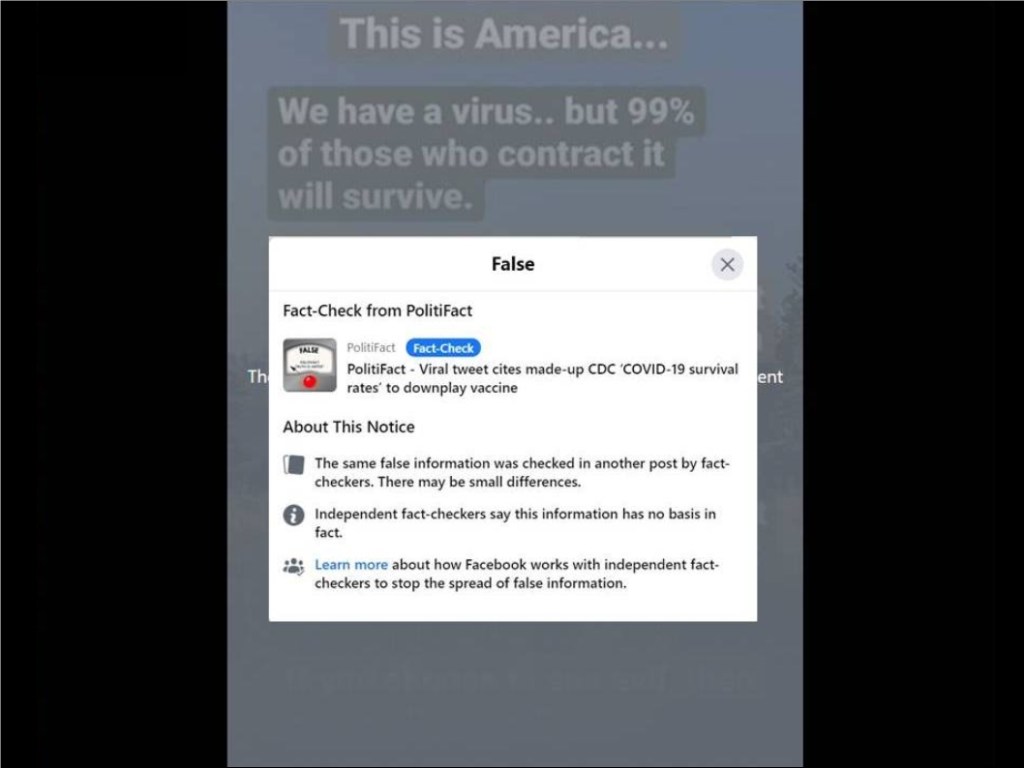
They got me. There I was, wicked and subversive, maliciously spewing false information across Facebook, the Spectrum Of Truth And Goodness. So they mercifully covered that horrifying meme I shared with a sign to let people know it was False Information, warning them away from that mind-warping evil.
Except they were wrong.
I chased that rabbit down that hole. Couldn’t help myself…the OCD monster must be fed. But I wanted to take a close look at how their fact-check process worked, and validate it for myself. So I’m a psycho masochist…I can live with that.
But I do have a problem with a system that brands a positivity-boosting meme as false information with rationale that is, itself, riddled with falsehoods and blatantly agenda-driven. So I’ll post the link to the PolitiFact analysis they used so you can go down that same rabbit hole if you really want to, or you can take this at face value, or just ignore this foolish sputtering of a nutcase, as you wish. But Facebook is using this process as a way to shape thought and push agendas, and people need to understand that.
Maybe this is all a bit nitnoid and petty, but gee, Mom, they started it! Maybe it’s a good idea for somebody to get up on their hind legs and tilt at the windmill now and then, to fuss a little at the rich and powerful rulers of our destiny, just to remind them that we’re not happy with what they’re doing. Maybe if a few thousand do it, they’ll think about the errors of their ways, and if it’s just me, the black helicopters and assassin squads should be here any minute to tell me to hush. Tell my story to the world, my friends.
The part of my post they had a problem with was, “We have a virus…but 99% of those who contract it will survive.” The warning they pasted over it indicates the same information was fact-checked in another post and found to be false, so this one must be false. The link they offer as evidence goes to an analysis of a tweet that listed very specific Covid survival rates and said those figures come from the CDC.
PolitiFact says they checked with the CDC and were told they don’t have that data. They don’t collect it, they don’t publish it, they have no idea where social media users are getting this information, and it’s way too complicated a thing to actually know about until maybe five years later. And then PolitiFact posts a link to the CDC site that shows they DO collect that data and they DO publish it. “Publish” may not be the precise word for what they do, but it does exist and it’s right there on the CDC website, and accessible to the public, and that says “published” to me. So I’ll include that link as well and you can double-check all you’d like. But they don’t call their data “survival rates.” They call it the “current best estimate” of “infection fatality rates,” which is an inverse and easily converted with basic math. And PolitiFact admits that those numbers correspond to the data given out in that tweet. The CDC explains that these figures are “only for planning purposes,” but, well, data is data, isn’t it? And they do explain that their information is “the best estimate, based on the latest surveillance data and scientific knowledge.”
I checked the current CDC link, and it’s not a perfect match to the tweet, but the CDC data is constantly updated, just like that web page says it is, so of course they wouldn’t always be precisely the same. But wait…at the bottom of the CDC page, there are three PDF archive files. The one dated September 10, 2020 is the one that would have been current when the tweet was tweeted and when the facts were checked. And THAT one is an absolutely perfect match to the information in the tweet. And PolitiFact saw that data because they referenced it. And the CDC people who run that page had to have known it was there, so why did they say they didn’t have that information and had no idea where people on social media got it from? And why does PolitiFact say it’s false information and the statistics are made up?
Their justification starts by saying the tweet was posted “to downplay the severity of the virus and the need for vaccinations,” which is a conclusion on their part because they don’t know for sure that it wasn’t just to create a dialog and get some good rationale from the CDC…they aren’t inside the poster’s head. They’re using an assumption, not fact. But that has nothing to do with whether the tweet is false or not. It does, however, show that PolitiFact has a problem with someone calling into question the need for such a big push on vaccinations.
Another part of their rationale was that another post used the same data to say the CDC thought the corona virus was less severe than the flu, and that post was debunked. Okay, but that doesn’t mean the data itself was debunked, so it really has no bearing on this case.
And then they said that the tweet ignored the fact that even if the death toll was only 1.8%, if everyone in the whole country was infected (which seems unlikely) it would still mean 6 million people would die. And, well, gee…that would be awful. They’re right, it would. But that doesn’t have anything to do with whether the data was false or not, now does it?
Their final rationale was “A widespread vaccination effort would prevent more deaths, protect people from severe illness, slow the spread and put the U.S. on a path back to normal.” This ties in with the accusation that the tweet was posted to downplay the severity of the virus. So it sure looks like the overall objective of this fact-check is to totally discredit the data, though it’s exactly the same as the actual CDC estimates, and convince people that the vaccinations are a good thing. That doesn’t really sound like fact-checking, does it? It sounds a little…or a lot…like an effort to convince people to think in a particular way.
I’m not against vaccinations at all. I’d have been quite satisfied if the original tweet’s question to the CDC about why they’re pushing the vaccinations had been answered by the CDC explaining why they’re pushing the vaccinations. But for Facebook and PolitiFact to slap the tweeter down and call her a liar? Seems pretty harsh, agenda-driven, virtue-signaling, and power-hungry to me. And done with their own lies, to boot.
And then they went and smacked down my post because it was similar. I didn’t even write it, though I wish I had because it felt good and said good things. It was a think-positive post and didn’t even mention the CDC, but it did say that 99% of the people who contract the virus will recover. That’s a ballpark estimate I agreed with from most of the anecdotal evidence I’ve heard, plus the fact that the CDC’s actual figure is an extremely-close 98.2%, based on confirmed cases reported to the CDC and confirmed deaths reported to the CDC, plus a widespread and probably accurate belief that a whole lot of people contracted the virus but stayed home, and self-quarantined, and got better without going to see a doctor. And besides, the meme I posted said “will recover,” so it also takes into account that more people are getting vaccinated and healthcare approaches are getting better and that means more and more people are likely to recover as time goes on. Doesn’t that make sense? And it’s a prediction. Politifact can’t possibly know if it’s true or false before it happens…just that they disagree.
And gee whiz…it was a post to point out to people that there’s too much negativity in the news and on Facebook and in our lives, and maybe it would be a good thing for us to focus on the fact that even though there’s a small percentage of bad out there, there’s a huge percentage of good. That seems like a reasonable thing to focus on.
So the point is that Facebook and the other social media giants are squashing the free and open exchange of ideas that they say they cherish so much, as it suits them. They think they know best about what information we should be allowed to see, to guide our thoughts in the right direction. For our own good, naturally. And it’s not just me, of course. They’ve been doing this a LOT. They even block legitimate news articles from reputable media sources when it suits them. So what if they decide they should block somebody’s post that says “God loves you” if it doesn’t provide measurable, statistically verifiable evidence that God actually exists and that He does actually love you? Will they smack down the Weather Channel’s forecast for this weekend because it might keep people from going out to get vaccinated if it’s going to be stormy? And why didn’t they fact-check the meme I posted a few days ago that says the dark matter that holds the universe together has finally been identified as coffee? That’s actually not true, by the way, at least according to the latest published information from the CDC. But it was funny. I’m not sure funny is going to be allowed for much longer.
Does this dissertation actually make a difference in the big scheme of things? Doubtful. But if enough people show their displeasure at being controlled by the Facebook Thought Police, maybe they’ll mellow out a little and perhaps allow people to make up their own minds about what they’re seeing. It could happen. Think positive.
If you’ve stuck with me this far, I salute your strength of character and/or masochism. Thanks for listening. Spread this as far as you’d like or ignore it and shake your head at the lengths some people will go to when they’re flailing ineffectively against the overreach of the high and mighty. At least I got it off my chest.
Yes, I’m much better now. Thank you.
Okay, okay, three posts in a row about genres and maybe now I can lighten up about it a little. In my defense, at least they’ve had different perspectives! And it’s cool learning things and expanding your horizons, so there’s that.
But on top of all that, it’s good to be able to home in on just the right description of what you write, or at least what you want to write, for those of us who are a little too hesitant or slow or procrastinating…or whatever adjective makes you feel better about not writing enough. Homing in on that description can help you focus your intent enough to get you going, or it can help you explain your project to that agent/editor/publisher you’re about to talk into a great publishing arrangement.
So here’s an article by Michael J. Vaughn, who is a novelist, poet, painter, drummer, and many things…so many things he needs two different author pages on Facebook to handle them all. He’s also a contributor to Writer’s Digest, where I found this, and where I end up finding a lot of good stuff. So it would be a great idea to subscribe to their newsletter if you don’t already, and you can find even more good stuff. This particular good stuff is a very, very thorough explanation of a whole slew of genres and sub-genres, and it can at least be an interesting analysis of the business even if you are already firmly convinced of your particular position in the literary firmament. And some decent food for thought if you wobble a little about it. Or a lot.
Here’s a breakdown of some of your favorite fiction genres, including romance, horror, thriller/suspense, science fiction/fantasy, and mystery/crime. Find more than 100 fiction sub-genre descriptions for writers.
Michael J. Vaughn
Updated:Mar 16, 2021 – Original:Mar 19, 2008
Editor’s Note: One of the most important things a writer can do when trying to pitch their novel is to identify the correct genre for their book. Knowing the correct sub-genre only improves a writer’s chances, because it shows an understanding of the market that not every writer has.
As such, enjoy this listing of sub-genre descriptions for several popular fiction genres, including romance, horror, thriller/suspense, science fiction/fantasy, and mystery/crime.
Chick-Lit: often humorous romantic adventures geared toward single working women in their twenties and thirties.
Christian: romances in which both hero and heroine are devout Christians, typically focused on a chaste courtship, and mentioning sex only after marriage.
Contemporary: a romance using modern characters and true-to-life settings.
Erotica: also called “romantica,” a romance in which the bedroom doors have been flung open and sexual scenes are described in candid language.
Glitz/Glamor: focused on the jet-set elite and celebrity-like characters.
Historical: a romance taking place in a recognizable historical period.
Multicultural: a romance centered on non-Caucasian characters, largely African-American or Hispanic.
Paranormal: involving some sort of supernatural element, ranging widely to include science fiction/fantasy aspects such as time travel, monsters or psychic abilities.
Romantic Comedy: a romance focused on humor, ranging from screwball antics to witty interplay.
Romantic Suspense: a novel in which an admirable heroine is pitted against some evil force (but in which the romantic aspect still maintains priority).
Sensual: based on the sensual tension between hero and heroine, including sizzling sex scenes.
Spicy: a romance in which married characters work to resolve their problems.
Sweet: a romance centered on a virgin heroine, with a storyline containing little or no sex.
Young Adult: written with the teenage audience in mind, with a suitably lower level of sexual content.
 In A Tale-Spin